
The conflict may disrupt Budget 2026-2027 projections, squeezing revenues and raising subsidies, prompting fiscal adjustments and potential reforms, echoing lessons from the Covid-era shock, points out A K Bhattacharya.

Taking both direct and indirect taxes, the gross collection is expected to grow 10.45 per cent to Rs 33.61 trillion in 2023-2024.

India's net direct tax collections increased by 5.12 per cent to over Rs 23.40 lakh crore in the 2025-26 fiscal year, but this figure still fell short of the revised budget target of Rs 24.21 lakh crore, primarily due to income tax cuts implemented earlier in the year.

Despite zero publicity, mythological film Krishnavataram has shown a surprising fight at the box office, while family drama Daadi Ki Shaadi struggled to find an audience.

India's fertiliser subsidy bill is projected to increase by approximately 70,000 crore, reaching around 2.41 trillion in FY27, primarily due to rising import costs exacerbated by the ongoing West Asia crisis.

The Indian government has marginally exceeded its indirect tax collection target for fiscal year 2025-26, with strong performances in customs, excise, and GST revenues.

The Reserve Bank of India (RBI) is anticipated to make its highest-ever dividend payment to the government this year, providing a significant fiscal boost to address challenges, including those stemming from the ongoing Middle East crisis.

The total expenditure on the MGNREGA programme, as per the revised estimates from 2025-26, was Rs 88,000 crore, while initially, a sum of Rs 86,000 crore was allocated.

There is a minimum requirement of Rs 2.5 trillion capital expenditure every year and it is understood at the highest levels of the government.

'If you go by the capital expenditure, this is a good defence budget. But we will have to see if the government can keep defence spending at 2 per cent or higher in 2027-2028.'

Finance Minister Nirmala Sitharaman announced a fiscal deficit target of 4.3% of GDP for FY27, continuing the path of fiscal consolidation. The government aims to reduce the debt-to-GDP ratio to 55.6% by BE 2026-27 and further to around 50% by March 2031.
Under Mission Sudarshan Chakra, the country's national security shield is to be expanded by 2035 to ensure comprehensive protection of both strategic and civilian critical infrastructure.

After a gap of three years, direct tax collections -- which include corporate tax and personal income tax -- have exceeded the Budget estimates for FY'22, indicating economic recovery.

In 2025-26, the government allocated Rs 6,81,210 crore for defence budget.

The Union Budget 2025-26 had allocated Rs 2,33,210.68 crore (BE) to the ministry helmed by Union Home Minister Amit Shah.

Showing signs of financial strain, the government's fiscal deficit in the first five months of the ongoing financial year has already touched 74.6 per cent of the budget estimate.

Indian oil marketing companies are incurring significant losses, selling petrol at a Rs 14 per litre loss and diesel at Rs 18 per litre, as elevated global crude oil prices, exacerbated by the West Asia crisis, outpace capped retail fuel rates, according to rating agency Icra.

The Centre has announced that the Viksit Bharat -- Guarantee for Rozgar and Ajeevika Mission (Gramin) Act will come into force across the country from July 1, replacing the Mahatma Gandhi National Rural Employment Guarantee Act.

The idea of back-loading the target of fiscal consolidation is perhaps guided by the government's desire to be prepared for any adverse developments in the coming year, points out A K Bhattacharya.

Infographics break down the key numbers and decisions, making it quick and easy to understand what the Budget means for the economy.

India's fiscal deficit touched Rs 4.57 lakh crore or 84.4 per cent of budget estimates in the first seven months of the current fiscal, reflecting signs of stress in government finances.

Here are the key numbers to watch out for in the Union Budget for 2025-26:

India's fertiliser subsidy bill for the current financial year (FY27) is projected to increase by approximately 20% due to surging global prices, primarily driven by the West Asia crisis, a senior official confirmed. Despite this, retail prices for urea and di-ammonium phosphate (DAP) will remain unchanged, ensuring adequate supply for the kharif season.

India's state-run oil marketing companies (OMCs) are projected to incur under-recoveries of approximately Rs 80,000 crore on liquefied petroleum gas (LPG) sales in FY27 if current loss levels persist, according to rating agency Icra.

Of the Rs 31,820.80 crore allocated to central sector schemes and projects, only Rs 11,868.05 crore was utilised, according to the revised estimates.

The Union Budget for 2026-27, presented by Finance Minister (FM) Nirmala Sitharaman on Sunday, which was a first, had an excellent domestic macro backdrop. According to the first advance estimates, gross domestic product (GDP) in constant prices is projected to grow 7.4 per cent in the current financial year, against 6.5 per cent in 2024-25.

India's economy experienced a growth of 7.8 per cent during the October-December quarter of 2025-26, according to the new series of national accounts with 2022-23 as the base year.

The fiscal deficit situation during April-May of the last fiscal was 37.5 per cent of the Budget estimates.

In absolute terms, the fiscal deficit, or gap between expenditure and revenue receipts, stood at over Rs 5.07 lakh crore (Rs 5.07 trillion) at the end of February, according to the data released by Controller General of Accounts on Thursday.


The government on Sunday gave a strong push to upgradation and expansion of healthcare infrastructure, medical education and pharma sector with the Union Budget 2026-27 announcing a slew of steps, including those aimed at making India a global hub for allied healthcare professionals and biopharma manufacturing.
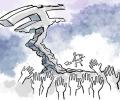
India's fiscal deficit is projected to reach 4.5 per cent of GDP for the current fiscal year, exceeding the budgeted target, as the government's policy responses to the West Asia conflict are expected to strain public finances, according to research firm BMI.

The fiscal tilt towards capex benefits companies in investment-related sectors like capital goods, defence equipment, engineering & construction and metal & mining. The planned cut in revenue expenditure will weigh on companies in consumption sectors like FMCG, consumer durables and retail.

Riteish Deshmukh's Raja Shivaji has become the highest-grossing Marathi opener ever, while Aamir Khan's Ek Din faced a disastrous opening at the box office.

Finance Minister Nirmala Sitharaman's biggest challenge will be to find a new growth driver, particularly against the backdrop of a global economy ravaged by heightened uncertainty and fragmentation, financial markets on a precipice, and global commodity prices on a continued uptrend.

Manufacturers are planning a hike of over 15 per cent in the second quarter of calendar year 2026, as memory prices shoot through the roof.

Direct tax realisation, however, is likely to fall short of the enhanced target of Rs 3.87 lakh crore (Rs 3.87 trillion), mentioned in the revised estimate for 2009-10.

While India's interplanetary ambitions remain significant, the current pace of financial and technical progress raises questions about whether the 2027-2028 timelines can be met.

While presenting the Union Budget to Parliament earlier this month, Finance Minister Nirmalal Sitharaman had raised fiscal deficit target to 3.8 per cent of the GDP from 3.3 per cent pegged earlier for 2019-20 due to revenue shortage.

Air India expects to wipe out some red marks from its balance sheet.
 © 2026 Rediff.com - Advertise with us - Disclaimer - Privacy Policy - Sitemap - Feedback - About us - Terms of use - Grievances